Saturday, August 21, 2021

A photo workshop in Santa Fe…

I did a tour/photo workshop with a professional photographer in Santa Fe.  David Hoptman is a talented fine artist running the workshops.  I really enjoyed hearing his advice and guidance on how to slow down and carefully compose a shot.  My normal modus operandi is to shoot hundreds of photos and hope that one turns out well.    

Here is a selection of what I consider the best shots from my time with David today.  David stopped at some interesting spots on the road to Chimayo, and I took some shots in this quaint Native American village.

I plan to follow his advice and slow down in composing the shot, review them and determine how to make the shot much better.


Help! I cannot breathe!

When I arrived at Lamy, NM, I was out of breath going the short distance to the van that was to transport me to the hotel. 

Yesterday, I was so winded moving my bags from the lobby of the hotel to my room.  It reminded me of my condition prior to my heart valve replacement.

I know I’m overweight (it’s the pandemic 75 instead of 10 lbs. for me), but I do exercise each day for 30 minutes on a sitting elliptical device.  I was afraid something was wrong!

Well, I realized what it is today.  It’s the elevation.  The City of Santa Fe itself sits at 7,198 ft. above sea level.  It is the highest capital city and third highest city in America.  West Columbia, where I live, sits at an elevation of 285 ft. above sea level.

According to Wikipedia… "The effects of high altitude on humans are considerable. The oxygen saturation of hemoglobin determines the content of oxygen in blood. After the human body reaches around 2,100 meters (6,900 ft.) above sea level, the saturation of oxyhemoglobin begins to decrease rapidly.  However, the human body has both short-term and long-term adaptations to altitude that allow it to partially compensate for the lack of oxygen."  The body compensates by the “huffing and puffing” to get more oxygen into our bloodstream.

There are three levels that impact the human physical condition:

·        High altitude = 4,900–11,500 ft. (Santa Fe = 7198 ft.)

·        Very high altitude = 11,500–18,000 ft.

·        Extreme altitude =18,000 ft.


When I’ve traveled in the past to "high altitude" locations, the guides had us drink lots of water and not exert oneself.  In fact, in Cusco (South America) they gave us coca leaf tea upon arrival at our hotel to prevent altitude poisoning.  Cusco in Peru is at an elevation of 11,152 ft. 

My suspicions were confirmed this morning from my instructor doing my one-on-one photography class.  After the session I’m doing what’s best to prevent sickness, “The best way to prevent altitude sickness is to go slow — called acclimatization. This process allows your body time to adjust to the change in oxygen levels.”  With my age I plan to go slow!

I wish I had some of the cocoa leaf tea, but it's only legal to drink in certain South American countries (and restricted in the USA).

Friday, August 20, 2021

The diversity and beauty of the mid-west to the southwest

It was great to see the changing scenery as the train left the farming areas (soybeans and corn were everywhere) to the grazing lands occupied by cattle.  Finally, the desert landscape was in view.  This landscape reminded me of those cowboy movies of yesteryear. 

Corn and Soybeans (and the occasional wind turbine) were found in the Midwest.

I just happened to get this shot of the Mississippi.  It separates Illinois and Iowa.  That's the bridge we crossed.

This train follows the Santa Fe Trail, so there were reminders along the way.  We even stopped in Las Vegas, NM (not NV) before reaching Lamy (the stop for Santa Fe).


Much of the land had grazing cattle.  It was interesting to see those near the train run in the opposite direction as the train went by.

This was shot in New Mexico.

The landscapes looked like those old western movie shots.  Where's John Wayne?

They had an unusually wet time this year, and it is much green with water standing in spots.

I was on the east side of the train, and I missed the mountains.  You can catch a glimpse of the white topped mountains in the background.  I should be on the west side on the return trip.

I cannot get enough of those rocks and cliffs.

It's been much wetter for the folks in the southwest this year. 

Trees were found around where homes were built.  Of course, this home is no more.

The windmill seems to still be working, but the building has collapsed.

I seemed to have taken lots of old and dilapidated farm buildings.

Most herds run when the train was nearby.  This cow just seemed curious.


I'm surprised the photos came out pretty good.  I took them from a fast moving train.

The train moved slowly as we moved upward to over 7500 feet in elevation.  

This was the rear of the SW Chief.  You could see this portion of the train as we went around curves.  The sleeping cars were at the back of the train.


Once in Missouri, the train moves roughly the same route as the original Santa Fe Trail.  I don't believe we went through Oklahoma, but through Colorado.

The train went through one tunnel called the Raton Pass which is 7588 feet in elevation (highest point on the trail).  It wasn't announced, and things just went black on the train (there are no lights inside a train tunnel)!  According to Wikipedia, "The tunnel is entirely within New Mexico, with its northern portal only a few feet south of the Colorado border."  I couldn't get a picture, but here's one compliments of Wikipedia.

I didn't take this photo, but it shows the Southwest Chief emerging from the tunnel heading toward Santa Fe, NM.  The gradient in this area was pretty steep, and the train moved slowly.


Leaving Chicago and my first meal on the SW Chief...

It was a great trip on the SW Chief.  This long-haul train (#03) makes the 40-hour trek from Chicago to Los Angeles.  We met the sister SW Chief (#04) in New Mexico.  It runs the route in the reverse (Los Angeles to Chicago), and I’ll return on it next week.

I took this as we exited the dark Union Square station.  Note the Sears/Willis Tower to the left.

The conductor must have been from Illinois.  He provided commentary of the Illinois towns (this stopped when the train reached Iowa).  He said the said Mendota was the most picturesque town.  Mendota's corn cob isn't as big as Gaffney's giant peach!

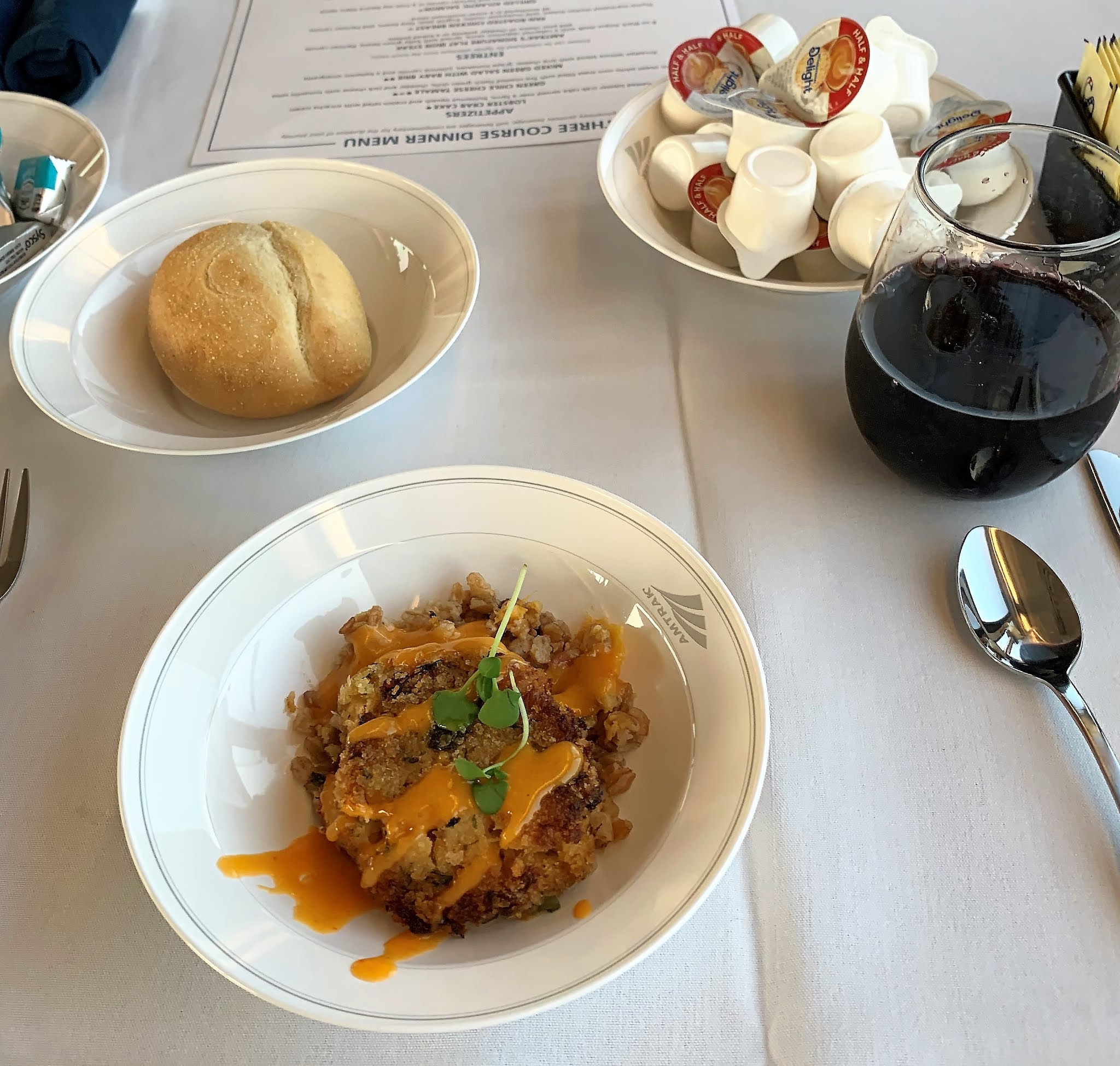
The SW Chief offers dining service for its sleeping car passengers.  You have the option of a reservation or they will serve you in your cabin.  I chose to eat in the dining car since they are social distancing at all times.  The three-course meal was delicious.  I had the lobster and crab cake on farrow as my appetizer.  It was followed by the perfect medium-rare steak.  I chose the carrot cake (hey, can’t it be considered a vegetable) for dessert. 

My dining attendant came to my sleeping room to find out my preferred dining time.

Meals (and one adult beverage) are included for those who have sleeping car accommodations.

Michael, my dining attendant, insisted he take my picture.  I also met the Chef Luigi.  

The lobster and crab cake on farrow was so delicious.

The steak and accompaniments were so good.  Note the carrots are spherical.